What is ayurveda?
Explaining ayurveda in a few words is a challenge. I have chosen to present the fundamental aspects, like explained in the book “Ayurvedic Anatomy and Physiology” written by Vaidya Atreya Smith.
Ayurvedic medicine is one of the world’s oldest medical systems, originating in India over 3,000 years ago. It is still widely taught and practised there today. Its name comes from the Sanskrit: ayur (life) and veda (knowledge), meaning “knowledge of life”.
As with Chinese medicine, the approach of this ancient medicine is preventive and holistic. It takes into account the patient’s body, mind, lifestyle and environment. There are three main founding texts of Ayurveda, written in Sanskrit around the 3rd century AD : Caraka Samhita, Sushruta Samhita and Ashtanga Hridaya.
Ayurvedic medicine is based on the Samkhya philosophy that the universe is made up of four states of matter or elements: solid (earth), liquid (water), state of transformation (fire), state of movement (air). These 4 states exist in a 5th state, space. Three principles or doshas regulate these five states of matter. They derive from the vital force, prana. 3 forms of prana, doshas, manage the 5 states of matter, the 5 elements, in living organisms.
The 3 doshas are observable, or their actions are observable. They are part of anatomy (structure) and physiology (functions), and also determine a person’s constitution (prakriti). They are also used to determine the causes and types of illnesses.
According to Ayurvedic medicine, our health, i.e. our general balance in both body and mind, is driven by these three fundamental energies : the doshas Vata (air and space), Pitta (fire and water), Kapha (earth and water) characterize our constitution. These three energies are present in each of us in different proportions. Each of us is unique.
In the ceaseless movement of life, these energies that animate us are constantly unbalancing and rebalancing. By acting against our individual nature (inappropriate diet, stress, bad lifestyle habits) or reacting inappropriately to an event that causes suffering and anxiety, we disturb this balance, and when our body is unable to restore it, this leads to health problems. According to Ayurveda, illness is the consequence of a lasting imbalance of the doshas, leading to the harmful storage of toxins (Ama).
Ayurvedic therapy aims to re-establish our primary balance, in particular by promoting the elimination of these toxins. For Ayurveda, maintaining good health, i.e. keeping the doshas in balance, requires proper nutrition, a healthy lifestyle and good mental management.
What are the benefits of massage according to Ayurveda ?
Together with a proper diet, the use of herbs and spices, yoga and meditation, massage is one of the tools that can help recovering a good health. Among other things, they help balance the doshas, eliminate toxins and calm the mind.
Some terms used on this site:
Vayus
Vayu means wind or breath in Sanskrit. The 5 main vayus are 5 vital movements in the body located in different areas of the body.
- Prana Vayu is located at the level of the sternum, Heart chakra. It corresponds to the energy that enters the body (air, food) and to the actions of breathing in, swallowing, thinking and perceiving. Air element.
- Apana Vayu is located in the pelvis, sacral chakra and root chakra. It corresponds to the energy of elimination, downward movement, excretion of urine, feces, sweat, negative emotions and childbirth. Earth and water elements.
- Samana Vayu, located at navel level, Solar plexus chakra, harmonizes Prana and Apana. It corresponds to the energy of transformation and assimilation (of food and emotions). Circular movement. Fire element.
- Udana Vayu is located at throat and head level, throat chakra, 3rd eye, crown chakra. This vayu corresponds to spiritual energy. Upward movement. Element Ether-Space.
- Vyana Vayu is found throughout the body, but starts from the heart, it is responsible for the body’s circulation of food and emotions. Dispersing movement.
Abhyanga massage respects these 5 movements.
Marmas
Marmas are energy crossroads, intersections of different tissues (veins, tendons, muscles…) and nadis (energy channels). They are located inside the body. There are 107 of them. During the massage, the marmas are stimulated by acupressure and circular movements with the thumb. Marma points, when gently pressed on the skin can stimulate a chain of positive events. Marma therapy helps to maintain health by cleansing blocked energy. It improves body and organ functions, immunity, digestion, breath and psychological functions.
Nadis
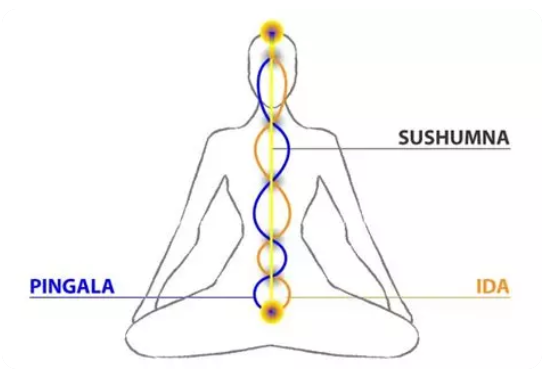
The nadis are the energy vessels that allow cosmic energy (prana) to circulate in the body. They are immaterial.
There are thousands of them, but there are three main ones:
Ida and Pingala, along the spine, and Sushumna inside the spine.
The chakras are located at the crossroads between Ida and Pingala.
Feet, hands, skull, neck and sense organs are energy gateways, special areas to be oiled and massaged to stimulate the nadis.